
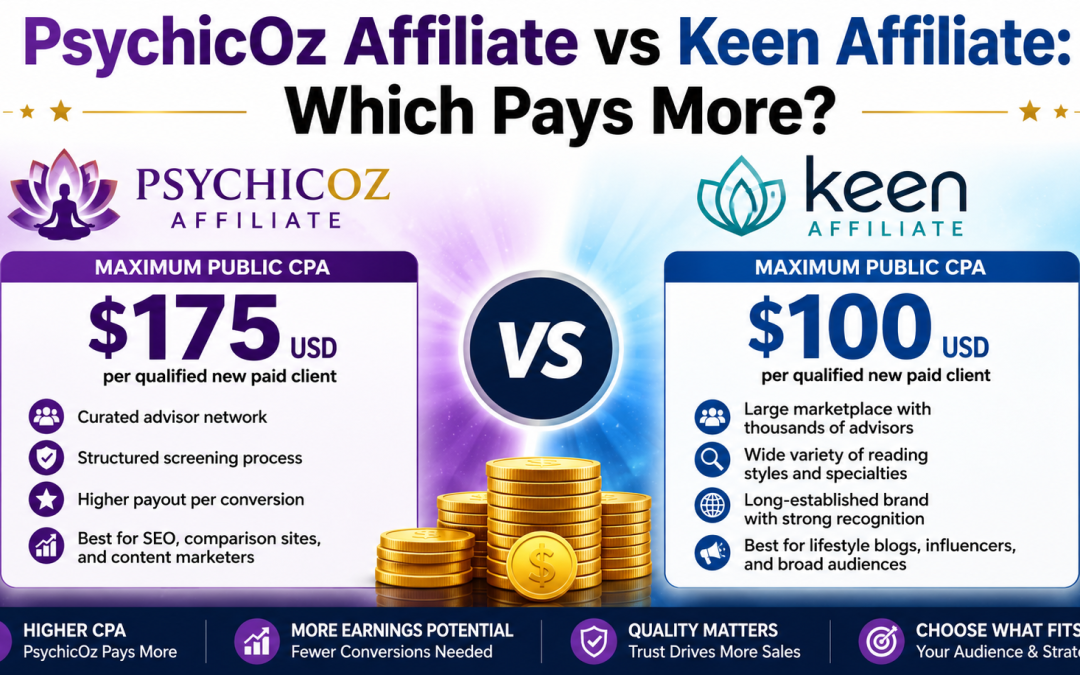
Two of the better-known psychic affiliate programmes are run by PsychicOz and Keen. Publishers comparing them usually want one number: which pays more?
The honest answer is that only one of them publishes enough information to answer that directly, and even if both did, the headline figure would not settle it. What follows is what each programme actually states, what you have to work out for yourself, and how to decide which suits the traffic you have.
Quick Guide: The Short Answer
- PsychicOz publishes its terms. $175 per qualifying new client, $101 spend threshold, 180-day cookie, monthly PayPal.
- Keen does not publish a commission figure. Its affiliate page describes a "bounty" for first-time paid customers without stating the amount.
- That gap is itself information. You cannot forecast against a number you have not been given.
- Attribution windows differ substantially. PsychicOz states 180 days; Keen's page references a 30-day conversion window.
- Headline rate never settles it anyway. Earnings per referred visitor does.
- Apply for both if you qualify. Joining costs nothing and reveals the terms you cannot see from outside.
What Each Programme Publicly States
The table below contains only what each programme publishes on its own affiliate page at the time of writing. Programme terms change without notice, so treat this as a starting point and confirm current figures at source before deciding anything.
| Criterion | PsychicOz Affiliate | Keen Affiliate |
|---|---|---|
| Commission | $175 per qualifying new client | Not published — described as a "bounty" for each first-time paid customer |
| Qualifying condition | New client reaching a $101 spend threshold | First-time paid customer |
| Attribution period | 180-day cookie | Not published as a cookie length; page references a 30-day window to convert free customers to paid |
| Payment | Monthly, by PayPal, at the start of each month | Monthly commission payments |
| Tracking | Affiliate platform with reporting | Third-party tracking with real-time reporting |
| Cost to join | Free | Free |
Sources: the PsychicOz affiliate programme page and the Keen affiliate programme page.
Why the Missing Number Matters
This is not an accusation of anything. Plenty of reputable programmes hold commission details behind an application, often because rates vary by publisher, region or traffic type.
But it has a practical consequence for you. Affiliate planning depends on knowing what a qualified referral is worth, because that figure decides which content is worth producing, whether paid traffic could ever break even, and how much effort a conversion improvement justifies. Without it you cannot model anything in advance; you can only apply, find out, and then decide.
The reasonable response is to apply to both. Neither charges anything, and an application is the only way to see terms that are not published.
The Headline Rate Was Never the Answer
Even with both figures in hand, comparing commissions directly is the wrong calculation. Consider two illustrative programmes and a thousand referred visitors each.
| Programme | Commission | Conversion rate | Revenue per 1,000 visitors | Earnings per click |
|---|---|---|---|---|
| Example A | $150 | 1% | $1,500 | $1.50 |
| Example B | $75 | 3% | $2,250 | $2.25 |
The lower commission produces half again as much revenue. These figures are illustrative arithmetic, not either programme's performance, and the point is structural: the number that decides the comparison is earnings per referred visitor, which depends on the qualifying condition, the attribution window, the merchant's own conversion rate and how well your audience matches the service.
Five Criteria That Decide It
Commission is one of five, and rarely the decisive one
The Two That Usually Decide It
The qualifying bar
A higher commission behind a higher spending threshold is not automatically better. PsychicOz's $175 requires the referred client to reach $101 of spending; a programme paying less on a first purchase of any size will convert a larger share of the same traffic.
Which is better depends entirely on your readers. Content aimed at people comparing services and preparing to book seriously will clear a higher bar more often than content aimed at people trying a reading out of curiosity.
The attribution window
This is the criterion publishers most often underrate, and in this niche it matters unusually much. People rarely book a psychic reading the day they first read about one. They think about it, sometimes for weeks, often across several visits.
A 180-day window covers almost all of that consideration period. A 30-day window covers the first month and then stops crediting you, even if the reader returns in week six because of something you wrote. For a search-driven blog, where readers arrive through informational content long before they are ready to act, the difference is substantial — a pattern covered in our guide to internal linking for psychic sites.
Working It Out for Your Own Traffic
Once you are inside both programmes, the comparison becomes straightforward arithmetic. Send comparable traffic to each, over a long enough period for the attribution windows to play out, then compare one figure:
That number answers the question the headline rate cannot. It accounts for the qualifying bar, the merchant's own conversion performance, and how well each service matches your audience. The full method is set out in our guide to psychic affiliate earnings.
One caution: give it time. Comparing a 180-day programme against a 30-day one after three weeks will understate the longer window considerably.
What to Verify Before Joining Either
- The current commission and threshold, in the programme's own terms rather than a third-party listing.
- Traffic restrictions — paid search, brand bidding, social advertising, coupon and incentive traffic are commonly limited.
- Geographic eligibility, both for your traffic and for your own location.
- Payment threshold and method, including what happens to a balance below the threshold.
- Holdback and reversal policy for refunds, chargebacks and duplicate accounts.
- Reporting granularity — without click and conversion data by source you cannot run the comparison above.
- Termination terms, and what happens to pending commissions if the programme ends.
Several of these are more consequential than the commission rate and almost none of them appear in "best affiliate programme" listings.
Which Suits Which Publisher
A long attribution window suits you if…
Your traffic is mostly from search, readers arrive through informational content, and the gap between first visit and any decision is typically weeks. This is the common shape for blogs.
A lower qualifying bar suits you if…
Your readers are curious rather than committed, arriving from social or video, and more likely to try a small first purchase than to spend substantially.
A fixed per-customer fee suits you if…
You want to forecast. A known amount per approved referral makes planning far simpler than percentage-based arrangements.
Running both suits you if…
You have enough traffic to split meaningfully. Nothing stops you promoting different services on different pages where each genuinely fits better.
That last option is worth stating plainly, because comparison articles tend to imply a choice must be made. It does not. Most programmes permit membership of competing ones, and matching the service to the page usually outperforms picking one programme for the whole site.
Our Position, Stated Plainly
We promote PsychicOz. The published terms — a fixed $175 per qualifying new client and a 180-day attribution window — suit the kind of search-driven, slow-decision traffic this site is about, and the fact that those terms are published at all makes them possible to plan against.
That is a reason, not a verdict. We have not tested Keen's programme and cannot tell you what it pays, which is exactly why this article does not rank one above the other. Apply to both, run your own numbers over a full attribution cycle, and let your own data decide. Our detailed review of the PsychicOz programme covers its drawbacks as well as its terms.
Key Takeaways
- PsychicOz publishes $175 per qualifying new client, a $101 threshold and a 180-day cookie; Keen does not publish its commission figure.
- You cannot forecast against an unpublished rate, which is a practical reason to apply rather than speculate.
- Headline commission never settles a comparison — earnings per referred visitor does.
- The qualifying bar and the attribution window usually decide more than the rate.
- Long attribution windows matter unusually much in this niche, where decisions take weeks.
- Verify traffic rules, geography, payment thresholds and reversal policies before joining.
- Run the comparison over a full attribution cycle, not three weeks.
- You are usually free to join both and match the service to the page.
Frequently Asked Questions
Which pays more, PsychicOz or Keen?
PsychicOz publishes a fixed $175 per qualifying new client. Keen does not publish its commission amount, so a direct comparison is not possible from public information alone. The only reliable answer comes from joining both and comparing earnings per referred visitor with your own traffic.
Why does Keen not publish its commission rate?
Many programmes hold rates behind an application because terms vary by publisher, region or traffic type. It is common practice rather than a warning sign, but it does mean you cannot model potential earnings before applying.
How much does the cookie duration really matter?
A great deal in this niche. Readers often consider a psychic reading for weeks across several visits. A 180-day window covers most of that consideration period; a 30-day window stops crediting you well before many readers act.
What is a qualifying threshold?
The condition a referred customer must meet before a commission is approved — commonly a minimum first spend. PsychicOz states $101. A higher threshold reduces the share of referrals that qualify, which offsets part of a higher headline rate.
Can I join both programmes at once?
Usually yes. Most affiliate agreements permit membership of competing programmes, though you should check each one's terms. Promoting different services on different pages often works better than committing the whole site to one.
How long should I test before deciding?
Long enough for the longer attribution window to play out, which means months rather than weeks. Judging a 180-day programme against a 30-day one after three weeks will systematically understate the former.
What should I check beyond the commission?
Traffic restrictions, geographic eligibility, payment threshold and method, reversal and holdback policy, reporting granularity, and what happens to pending commissions on termination. Several of these matter more than the rate.
Do these terms change?
Yes, and usually without notice to publishers. Anything quoted in an article, including this one, should be confirmed against the programme's own current documentation before you act on it.
Is a fixed fee better than revenue share?
It is easier to forecast, because the value of an approved conversion is known in advance. Revenue share can be worth more where customers return regularly, but the outcome is less certain.
Should I trust a comparison written by an affiliate of one programme?
Treat it as one input and check the underlying sources. That is why this article links directly to both programmes' own pages, states which relationship we have, and stops short of declaring a winner we have not tested.
Final Thoughts
"Which pays more" is a reasonable question with an unsatisfying answer: it depends on your traffic, and one of the two programmes does not publish the figure you would need to guess.
What you can do is compare what is actually knowable — qualifying conditions, attribution windows, payment terms, traffic rules — apply to both, and then let three months of your own data answer it properly. That answer will be specific to your audience, which is the only version of the answer worth having.