

A psychic affiliate comparison page should answer a decision a reader can make before booking. Start with the format they can use, the budget they can afford and the conditions they need to understand. Save commission and tracking terms for the publisher’s evaluation so they do not set the reader’s order of choices.
Name the decision before building the shortlist
Imagine a reader who needs a quiet written chat, has $40 available and wants to avoid an ongoing charge. An offer with a low starting price but phone-only access cannot answer that situation. Find options that meet the format first. Then check the displayed price, minimum amount, what happens after the initial period and any renewal or refund terms.
For a psychic affiliate shortlist, you might begin by comparing the public terms for PsychicOz and Keen. Keep the reader-facing facts distinct from publisher questions such as eligible conversions, attribution windows, reporting and reversals. The guide to how psychic affiliate programs work explains those terms from the publisher’s perspective.
Read the visual guide as text
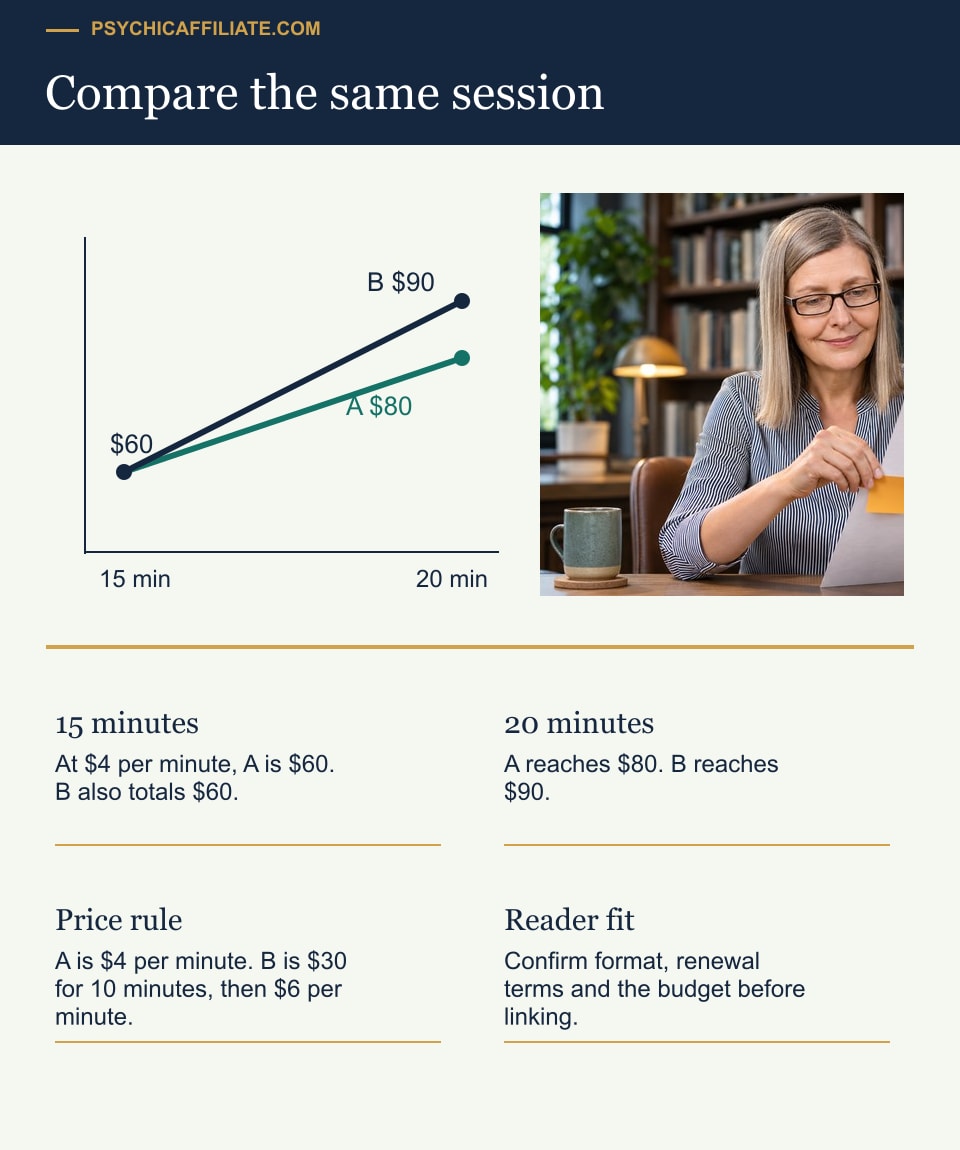
- 15 minutes. At $4 per minute, A is $60. B also totals $60.
- 20 minutes. A reaches $80. B reaches $90.
- Price rule. A is $4 per minute. B is $30 for 10 minutes, then $6 per minute.
- Reader fit. Confirm format, renewal terms and the budget before linking.
Build an evidence table you can maintain
For each claim, capture the program, the detail, the source, the date checked and any condition. A published rate claim should point to the public terms or the price displayed for the type of session you are describing. If you observed what appeared in a booking flow, label that as a visit observation. If a reviewer actually paid for a service, describe the particular experience and time period without generalizing it to every reader.
Use “Check before booking” for information that cannot be confirmed. Place the note next to the field it affects. If a trial does not state whether a chat transcript is saved, for example, put that in the privacy row. Avoid turning an interface check or an advisor profile into an accuracy claim.

Work through the same cost scenario twice
Imagine offer A is $4 a minute, and offer B charges $30 for the first 10 minutes and $6 a minute afterward. At 15 minutes, A is $60, and B is $30 plus 5 minutes at $6, also $60. At 20 minutes, A is $80 and B is $90. These hypothetical figures exclude taxes and other charges. A fixed session length lets readers see why an introductory offer can compare differently once the session runs longer.
Return to the visitor who needs a private chat and has $40. Under these hypothetical prices, A would cover 10 minutes and B would cover 11 whole minutes within that limit. The visitor still needs to check any minimum charge, the format, whether the service lets them stop promptly and whether other charges apply. Give a reader a reason to check their own quote before clicking.
Write conditional recommendations and check the mobile view
Use recommendations that name who they serve. “Worth considering if you want a shorter chat and the full quote fits your limit” tells someone how to use the comparison. A short card on mobile should show format, total estimated cost, one important condition and a direct link to the evidence when appropriate. Avoid hiding a condition behind a wide table or overlay.
When an affiliate publisher has a material connection to an offer, disclose it close to the relevant recommendation or link. Read the FTC’s endorsement guidance for examples of disclosures readers can understand. Keep educational guidance about a material connection tied to the publishers and links it actually applies to.
Keep a short review checklist and watch the right metrics
Test the page using the reader question, “I want a quiet written chat and can spend $40. What should I check next?” Ask someone to find the total cost and any ongoing charge on a phone. Then try it with a second reader who wants a longer call and cares about advisor choice. If they both land on the same generic recommendation, adjust the structure or wording so each can find their own answer.
Record a revisit date and review pricing, eligibility, disclosures and working links when an offer changes. Alongside traffic and clicks, track approved referrals, reversals and approved revenue for the same window. Compare that information with what readers can accomplish on the page before deciding whether to change the offer, the answer or the link path.
Frequently asked questions
1. Which details belong in a psychic affiliate comparison table?
Use fields that matter to the reader, such as session format, representative total cost, time limits, billing terms and privacy questions.
2. Should publisher commission decide the order?
Use a reader-focused criterion, such as format, the full price of a comparable session or an important booking condition. Evaluate commission separately.
3. What if an offer has no published refund or renewal detail?
Say which term you could not confirm and show the reader where to check it before booking. Date the information you did verify.
4. Can I describe an offer as tested after opening the booking flow?
You can describe what appeared in the flow and when you checked it. A paid session or an outcome is a different kind of evidence.
5. What is a good maintenance habit?
Keep a review date, store the source for each claim and recheck linked prices, terms and examples when a program changes.