

Why tarot suddenly feels like it is everywhere online
It’s difficult to overlook tarot when browsing Instagram or TikTok. Clarity is promised by pick-a-card readings. Real-time responses to comments during live tarot sessions. While text overlays say things like “this message found you for a reason,” serene voices are flipping cards.
Tarot seems eerily relevant to many viewers. Others find it ambiguous, incidental, or just amusing. The most frequent query is whether online tarot readings are truly accurate, and this tension feeds that question.
It’s a valid question, and a challenging one at that. In tarot, accuracy is not the same as it is in financial or weather forecasting. Tarot inhabits the liminal space between intuition, psychology, and symbolism. That space has been expanded by social media, which has made private interpretation techniques quick, public, and algorithmically shaped.
This post will explore how online tarot readings work and why they have gone so viral. We also discuss what people really mean by accuracy and why tarot seems to continue to resonate, even among the skeptics.
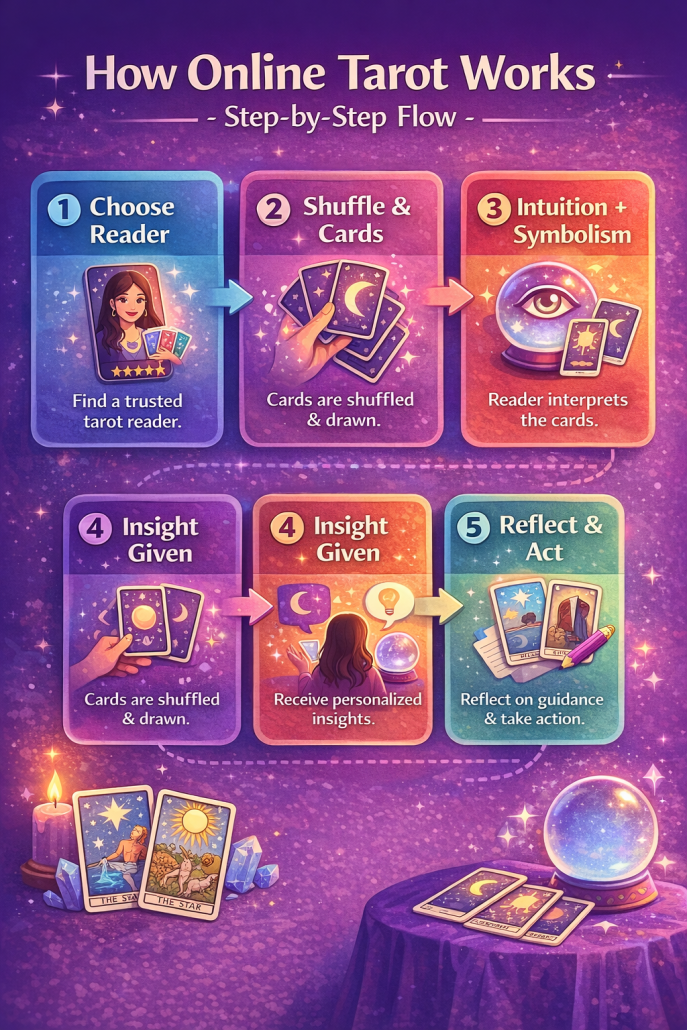
The Evolution of Tarot from Private Practice to Public Feed
Tarot before social media
Tarot was traditionally a private practice. Together, either in person or virtually, a reader and a client examined a question in a common setting. The cards focused more on timing, introspection, and emotional patterns than they did on making predictions.
Conversation produced meaning. Based on the client’s responses, inquiries, and life experiences, the reader modified their interpretations. There was a relationship between accuracy. Relevance, not certainty, was the deciding factor.
What changed online
Tarot became a broadcast on social media instead of a conversation. Today, a single spread can reach thousands of people. Collective identification takes the place of personal context.
That appears to be a loss at first glance. How can someone find a reading intended for “everyone” to be intimate? Ironically, though, mass tarot readings frequently seem incredibly specific.
The change isn’t a coincidence. Social platforms reward emotionally resonant language, symbolic imagery, and open-ended interpretation. Tarot fits that structure naturally.
What was gained and what was lost
What tarot lost in specificity, it has now gained in accessibility. People who may never book a private reading can now engage with tarot in a casual manner, so they can be repeat viewers while staying anonymous.
What was lost is the depth of readings. Without dialogue, readings risk becoming overly general. What was gained is the emotional reach. Tarot now functions as a form of shared reflective tool, not just a one-on-one service.
Why Tarot Content Went Viral on Social Media
Archetypes thrive in short-form video
The Fool, the Tower, and the Empress are the archetypes upon which tarot is based. Archetypes condense difficult emotional situations into straightforward pictures. For short-form platforms, that compression is perfect.
Without further explanation, a single card can allude to beginnings, endings, conflict, or care. Engagement rises as viewers fill in the blanks on their own.
Reliability and emotional timing
Tarot content that goes viral frequently does so by reflecting people’s current emotions rather than by making predictions about the future. When there is uncertainty, a reading about confusion is most impactful. When people are fed up with imposing their will on others, a message of patience resonates.
This isn’t a coincidence. Content that elicits an emotional response is given priority by algorithms. Even if the timing is collective rather than personal, tarot designers naturally gravitate toward themes that seem relevant.
The role of symbolic language
Symbols bypass rational filters. Instead of trying to argue or persuade, tarot invites interpretation. Viewers do not need to believe in tarot to gain some meaning from it.
Research from the American Psychological Association shows that humans naturally seek patterns and meaning when processing uncertainty. Symbolic systems like tarot give structure to that process. (https://www.apa.org/monitor/2016/03/belief)
Types of Online Tarot Readings People Encounter Today
Why do readings from anonymous sources seem intimate
In pick-a-card videos, viewers are asked to select between cards, piles, or symbols. Making a decision generates psychological investment. Relevance is inadvertently projected onto the selection by viewers.
Example: Millions of people viewed a pick-a-card reading with a love theme, framed around “divine timing.” Despite no direct communication, comment sections were crowded with people claiming that the message perfectly captured their circumstances.
Why it functions
Ownership is created by choice. Because the viewer took part in the reading, it feels intimate.
Live stream tarot readings
Live tarot streams allow creators to pull cards while also responding to comments. The interaction restores some of the relational elements lost in prerecorded content.
Example: A reader draws a single card and notices repeated comments about burnout. The reader then shifts the interpretation toward work stress instead of romance. The reading is able to adapt in real time.
Algorithm-shaped tarot content
Platforms amplify emotionally charged readings. Messages about endings, reconciliation, or sudden change tend to travel farther than neutral reflections. Over time, this shapes how tarot is presented online.
What People Mean When They Ask “Are Tarot Readings Accurate?”
Accuracy versus relevance
Statistical evidence is rarely requested when people inquire about the accuracy of online tarot readings. They typically mean something more straightforward and relatable, like “Does this apply to me?” or “Does this help me understand what I’m dealing with?”
Relevance, not prediction, is often the key to tarot accuracy. When a reading identifies feelings, trends, or tensions that the audience already perceives but hasn’t yet expressed, it seems accurate. In this way, accuracy ceases to be measurable and instead becomes experienced.
This explains why two people may react differently to the same reading. One feels profoundly observed. The other one shrugs and continues to scroll. Belief is not the difference. It’s resonance.
Emotional truth versus factual prediction
Social media tarot rarely succeeds by forecasting specific events. It succeeds by offering emotional truth. Statements like “you’ve been holding back to keep the peace” or “this situation feels unfinished” resonate because they describe internal states rather than external outcomes.
For many people, that internal recognition matters more than knowing what will happen next. Emotional clarity often feels like accuracy, even when no future events are named.
Why timing matters more than detail
A tarot message that arrives during an emotionally vulnerable time often feels sharper than one encountered during stability. Timingamplies the accuracy that is felt.
This does not mean tarot creates circumstances. It means interpretation lands differently depending on what the viewer is already navigating in life.
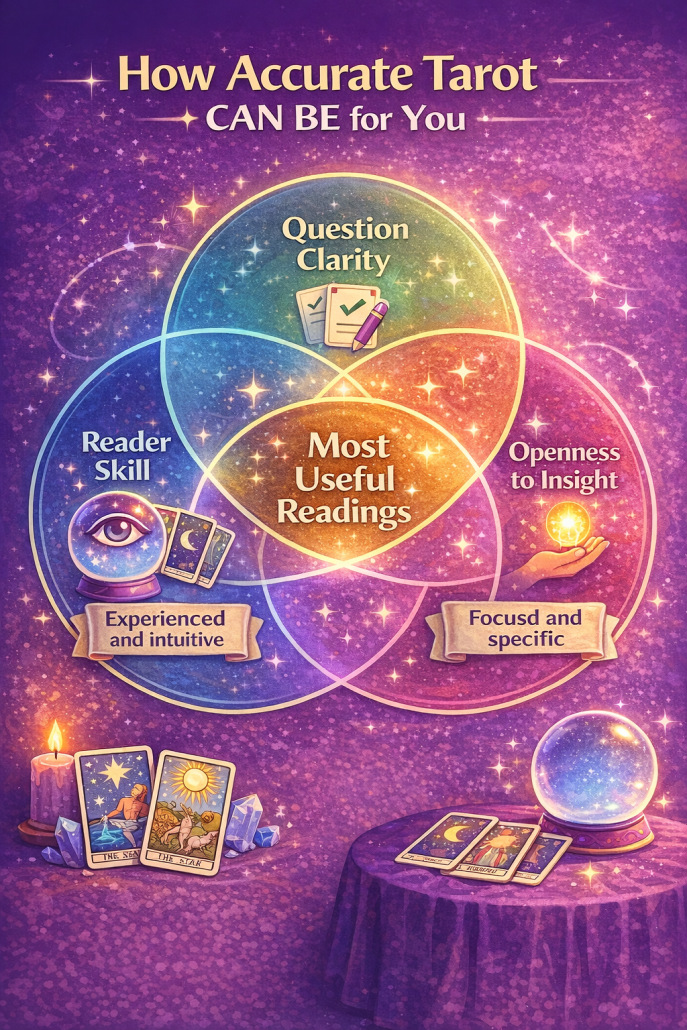
The Psychology Behind Tarot’s Perceived Accuracy
People are naturally drawn to patterns. The mind automatically fills in the blanks when given symbolic language. Just enough structure is offered by tarot cards to direct that process without restricting it.
Tarot is not the only game that uses this mechanism. People interpret stories, artwork, and musical lyrics for the same reason. Tarot merely codifies that procedure.
Symbolic flexibility and the Barnum effect
The Barnum effect explains how people interpret statements that are general enough to be applicable in a variety of contexts to have personal meaning. Tarot symbolism frequently functions in this area, providing adaptable interpretations based on the circumstances of each individual.
That adaptability isn’t always dishonest. It’s what makes tarot a reflective tool instead of a strict system.
Meaning-making as a coping strategy
Research from the Pew Research Center shows that many people engage with spiritual or symbolic practices during times of stress or uncertainty, even if they don’t identify as religious. Tarot fits this pattern by offering narrative structure when life feels fragmented. (https://www.pewresearch.org/religion/)
Tarot as Reflection, Not Fortune-Telling
Many modern-day tarot readers explicitly avoid predicting outcomes. Instead, they explain tarot as a mirror for current energies and decisions with strong emotional undercurrents.
This form of reframing is very common online because the large audience requires ethical restraint. Reflection-based readings reduce fear and empower viewers to make their own decisions and choices.
Guidance versus guarantees
Tarot feels most credible when it suggests possibilities rather than certainties. Phrases like “this may indicate” or “this often shows up when” invite contemplation instead of obedience.
Viewers increasingly respond to this language because it respects autonomy. Tarot becomes a companion, not a commander.
Why reflection feels safer online
Mass audiences will include people who are in vulnerable emotional states. Reflection-based tarot actively avoids triggering anxiety or dependency by focusing on interpretation over inevitability.
Social Media’s Influence on Interpretation
Comment sections shape meaning
It is rare that an online tarot reading will stand alone. Comment sections often refine, expand, or even correct interpretations. Viewers compare experiences and the nuances they hear while collectively negotiating the meaning.
This communal layer changes how accuracy is experienced. A reading may not feel precise in the beginning, but the discussion is what helps viewers contextualize it each time.
Feedback loops and amplification
Creators take notice of which themes generate engagement and unconsciously lean into them. Over time, certain tarot messages may become more common. This is not because they are true, but because they resonate so widely. This feedback loop does not invalidate tarot. It explains why certain messages feel repetitive.
The risk of overgeneralization
When tarot content becomes too algorithm-driven, nuance can be lost. Ethical creators counter this by reminding viewers that not every message applies to everyone.
Where Skepticism and Belief Overlap
Curious, not convinced
Lots of tarot viewers occupy a middle ground or grey area. They are not committed believers, but they are also not dismissive. They watch tarot the way people read horoscopes with curiosity and selective engagement.
This space, somewhere between belief and skepticism, is where tarot thrives online. It does not demand certainty. It offers perspective.
Tarot as part of modern wellness
Tarot increasingly sits alongside journaling, meditation, and therapy-adjacent practices. It is less about the mysticism and more about self-inquiry. This shift explains why tarot has remained culturally relevant even as audiences are becoming more discerning.
Professional Online Tarot Readings in Context
Casual content versus structured interpretation
Social media tarot is meant to be scalable. It conveys a symbolic meaning that many people can identify with. Professional online tarot readings, on the other hand, are meant to be in-depth. They involve conversation, follow-up questions, and context that is not possible with scalable content.
This is why some viewers enjoy viral tarot but still want to have private readings at critical junctures. The two types of content serve different purposes. One is meant for reflection in passing. The other is meant for in-depth investigation.
Why do some people want more in-depth, private readings
In situations that involve complex emotions, conflicting loyalties, or far-reaching implications, generic messages may not be enough. People want a place where they can pause and reflect on meaning without an audience.
In such situations, some people may use existing online platforms to get private tarot or intuitive readings. Such platforms provide a space that is conducive to conversation, which was the hallmark of traditional tarot readings.
Within this broader landscape, structured affiliate programs such as the PsychicOz affiliate program at affiliates.psychicoz.com are sometimes referenced by creators as optional pathways for private interpretation, framed as resources rather than answers. The emphasis remains on personal choice and reflective use, not guarantees.
Why neutrality preserves credibility
Mentions of professional services tend to be best received when they are contextual and optional. Viewers are more trusting when creators acknowledge that tarot is one of many tools people use to think through uncertainty.
This approach aligns with ethical standards around transparency and influence, particularly in affiliate contexts. (https://www.ftc.gov/business-guidance/resources/disclosures-101-social-media-influencers)
When Online Tarot Often Feels Accurate
Lack of personal context
Mass readings cannot address personal issues. A reading that speaks to the heart can still be off the mark in terms of realities, like cultural or psychological factors.
Literal interpretation of symbolism can lead to problems
When people interpret symbolic language literally, they can get into trouble. Good tarot readers always remind their audiences that tarot readings are tendencies, not certainties.
Timing incongruities
A reading can be perfectly valid but have nothing to do with a viewer’s present circumstances. When this happens, tarot readings seem vague rather than true.
Ethical Responsibilities of Online Tarot Creators
Avoiding fear-based messaging
Readings structured around themes of loss, punishment, or inevitability can often create an atmosphere of anxiety. A good creator will ensure that the language used does not force the viewer into a position of dependence or fear.
Boundaries
Tarot on the internet should never be a substitute for mental health care or advice. A good tarot reader will always establish boundaries and advise the viewer to seek help when necessary.
Why balanced tone builds trust
Research on parasocial interaction shows that audiences trust creators who communicate with nuance and restraint rather than certainty. (https://journals.sagepub.com/doi/10.1177/1461444820922781)
What Research Suggests About Symbolic Systems
Symbols as cognitive tools
Humans employ symbols to navigate complexity. Tarot, as a form of storytelling or metaphor, breaks down abstract emotions into meaningful patterns.
This does not involve a belief in supernatural energies. It is based on how the human brain looks for meaning.
Comparisons to therapy and narrative practices
Narrative therapy, journaling, and reflective coaching are practices that use symbolic frameworks to help individuals reframe experiences. Tarot readings take place in the same realm but with cards instead of questions.
How Viewers Can Use Online Tarot Responsibly
Questions to ask while watching
Viewers benefit most when they ask:
- What part of this resonates with me
- What doesn’t apply right now
- How can this insight inform my choices
Knowing when to seek private guidance
When questions become complex or emotionally charged, private conversations often provide clarity that mass content can’t.
Preserving agency
Tarot works best when it supports decision-making, not replaces it.
The Future of Online Tarot
From spectacle to emotional literacy
With the maturing of audiences, there is a shift in tarot content from the sensational to the thoughtful. A slower tempo and more contemplative speech are becoming popular.
Influence of platforms and moderation
The changing nature of platform policies may also promote responsible communication, particularly with regard to mental health and addiction.
Conclusion
Are online tarot readings accurate? The question depends on what one means by accuracy. If accuracy is a matter of precise prediction, then social media tarot is likely to be disappointing. But if accuracy is a matter of emotional resonance, reflection, and perspective, then tarot is likely to be successful.
In the age of the internet, tarot is less a form of prophecy and more a language of uncertainty. The fact that it continues to be popular is a sign that people are less interested in knowing the future than in understanding the present.
‘Pick-a-card’ videos are popular because they give people choices! It makes them feel involved even if it’s not super personal.
I think the virality of tarot content online shows how much we crave understanding ourselves better! Its also fun and engaging which helps too.
But why do we trust cards more than our own feelings? That’s something to think about.
Maybe it’s because cards can express what we can’t say ourselves sometimes!
While some may find comfort in tarot readings, it’s important to remember that they should not be taken as facts. They offer perspectives rather than definitive answers.
I wonder if these readings really help anyone or if they are just for entertainment? Maybe both?
I don’t know much about tarot, but I feel like it should not replace real advice from professionals. Sometimes, I feel these readings could mislead someone who is struggling.
‘Real advice’ is good but sometimes people just need something to connect with emotionally too.
Social media has changed how we view things like tarot readings! It’s not all about accuracy; sometimes it’s about connection.
The aspect of timing in tarot readings is fascinating! It feels like the right message always comes at the right moment when you’re feeling low.
‘Mass tarot’ makes sense as a trend, especially since everyone loves quick content online nowadays. But can anyone really connect with such general messages? Seems doubtful.
Yes, but I think some people might take it too serious. Like, can a card really tell you something? It’s hard to say.