

Why Blog Structure Matters More Than Belief
If you are someone who publishes psychic affiliate content for long enough, you will start to notice a pattern that has absolutely nothing to do with the algorithms and everything to do with human nature. The posts that convert are rarely the most mystical. They are, however, the most organized.
Readers arrive at psychic content in a particular mental state. It is most often curious, cautious, and typically, emotionally overloaded. They do not want a lecture. They definitely do not want to be sold to. They want to feel oriented, and the structure of your article can provide just that.
This is even more important today because the “psychic audience” is not a small fringe group. Pew Research Center found that 7 in 10 U.S. adults describe themselves as spiritual in some manner, including 22% who are “spiritual but not religious.” Pew Research Center+1 That does not mean everyone is a believer in the same way. It simply means a large mainstream audience is open to reflective, meaning-making practices. The job your blog has is to meet them where they are: being open but selective.
This further matters because people seek frameworks when they feel uncertain. The American Psychological Association’s guidance on dealing with uncertainty highlights how stress rises when outcomes feel unclear and why structured coping strategies help people regain footing. APA Psychic content can serve a similar role for some readers. This is not a certainty, but as a structured conversation that helps them think and feel more clearly.
That is where the persuasive angle lives within the niche. Not in guaranteed predictions, but in the simple, credible idea that reflective guidance can help people reframe, decide, and move forward.
What follows here are seven blog post formulas that consistently work for psychic affiliates because they align with reader intent, reduce skepticism, and make affiliate mentions feel like optional resources rather than the point of the overall article.
“Works Every Time”: What It Really Means
There is no formula that guarantees traffic. No single structure guarantees conversations. “Works every time” means something much more practical. It means:
- The post reliably keeps readers on the page
- The post reliably answers the question the reader came with
- The post reliably earns trust instead of triggering suspicion
- The post reliably creates a natural moment where an affiliate option makes sense
In other words, these formulas work because they respect the reader’s psychology.
The Psychic Affiliate Reader (in Plain English)
Before you choose a specific formula, it is helpful to understand what is happening in the reader’s mind. Most readers are not starting as firm believers. In fact, many visitors arrive with a stance that is reflected in one of these statements:
Firm Believers
- “I’m not sure what I believe, but I’m open.”
- “I’m curious, but I don’t want to be taken advantage of.”
- “I don’t need magic, I need clarity.”
Pew’s reporting on spiritual identity underscores that spirituality is often exploratory, personal, and mixed with skepticism rather than rigid and absolute. Pew Research Center
Emotional Intent, Not Product Intent
In many affiliate niches, the query is completely transactional with things like: “Best laptop under $1000” or “Top blender for smoothies.”
But in psychic niches, the query is emotional:
- How do I stop overthinking?
- Will I ever trust again?
- Why do I keep repeating this pattern?
- What happens in a psychic reading?
Your article has to translate emotion into structure.
Readers Have a Higher “Trust Threshold”
These readers are scanning for:
- Exaggerated claims
- Urgency language
- Fear-based persuasion
- Mystical vagueness that avoids specifics
- Anything that feels like a funnel wearing a robe
A formula will help you avoid all of these things while also keeping your writing grounded and specific.
Trust is the Product In Psychic Affiliate Blogging
In a normal affiliate post, the product is the product, but in psychic affiliate blogging, trust is the product.
Harvard Business Review has argued that content marketers need to operate more like publishers who are creating content worthy of attention in its own right, not just content designed to push an action. Harvard Business Review+1 That publisher mindset is the cleanest path to conversions in the psychic space.
It further protects your long-term SEO. If your posts remain structured, helpful, and framed in an ethical manner, they will age well. They attract repeat readers. They earn links. They also do not collapse the moment a platform changes distribution. With that in mind, we can move on to the formulas.
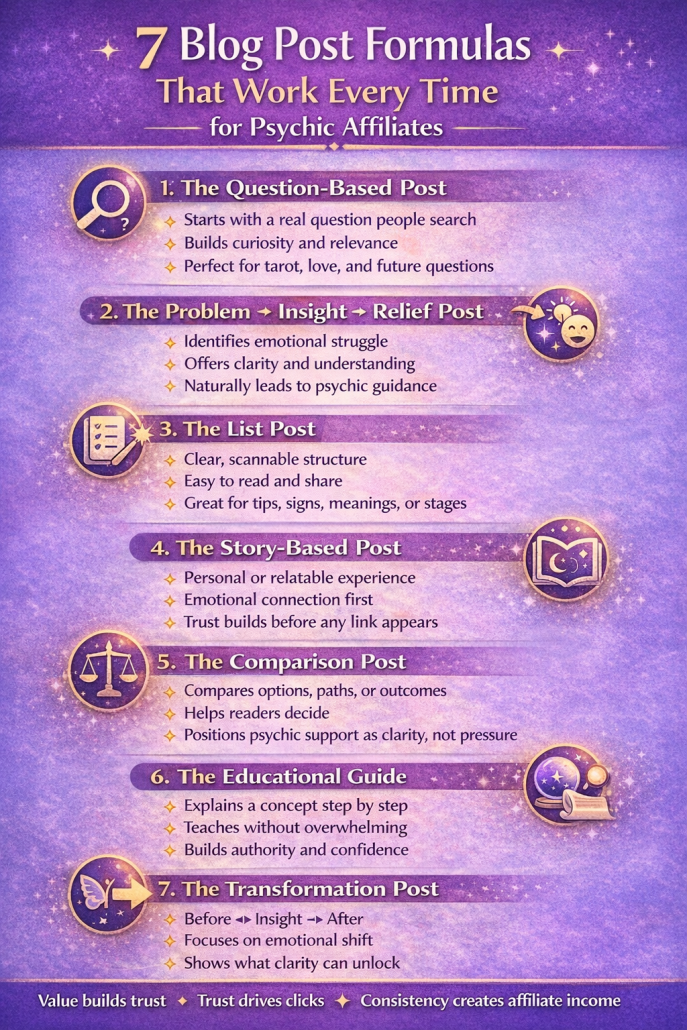
Formula 1: The “What to Expect” Explainer
This is the best-performing formula for first-time readers because it reduces anxiety.
Why it Works
Most beginners don’t avoid psychic services because they hate the idea. They avoid them because they don’t understand the experience. The brain distrusts what it cannot predict. Your explainer removes the unknowns.
This is also a highly “savable” format for Pinterest and shareable in newsletters because it functions as a reference guide.
The Structure That Converts
- Open with calm normalization
- Use language that makes readers feel normal for being cautious.
Example opening lines you can adapt:
“If you’re curious but cautious, you’re in good company.”
“Most first-time readers aren’t looking for certainty. They’re looking for a clearer way to think.”
Define What a Reading Is and Isn’t
Be explicit about boundaries. This builds trust fast.
A responsible framing:
“A reading is often an interpretive conversation about themes, patterns, and choices. It’s not a substitute for medical, legal, or mental health advice.”
Explain the Formats
Offer a simple comparison:
- Chat readings: lower pressure, easier to pause and reflect
- Phone readings: more conversational, faster rapport
- Video readings: more personal, sometimes unnecessary for beginners
Walk Through a Typical Session
Keep it simple:
- What you share (and what you don’t have to)
- How questions are asked
- How the reader responds
- How sessions typically end
- What “a good session” tends to feel like (clarifying, calming, reflective)
Include a “Red Flags” Section
This is essential for neutrality.
- Fear tactics
- Claims of curses
- Pressure to buy more
- Absolute guarantees
End with Optional Next Steps
This is where affiliate links belong: after the reader feels informed.
Specific Example Topic
What Happens in an Online Psychic Reading? A Calm First-Timer’s Guide
Micro-outline You Can Publish Today
- Intro: Why curiosity is normal
- Formats: chat vs phone vs video
- What happens step-by-step
- What to ask
- What not to expect
- Red flags
- How to choose a reader profile
- Resources and disclosure
Formula 2: The “Problem → Pattern → Perspective” Post
This is your relationship-and-life-transition powerhouse.
Why It Works
People often arrive saying, “Here’s what happened.” What they really mean is, “Help me make sense of this.”
This formula gives them meaning without promising destiny.
The Structure That Converts
Start with the problem as it feels in real life
Use concrete, relatable language.
Example:
You keep ending up in the same situation with different people. Different names, same emotional math.
Reveal the Pattern Underneath
This is the part that earns shares.
Common patterns:
- Confusing intensity with intimacy
- Over-functioning for love
- Choosing emotionally unavailable partners
- Staying for potential instead of reality
- Mistaking anxiety for chemistry
Offer Perspective, Not Blame
Frame patterns as learned strategies, not personal flaws.
Provide Reflection Tools
This is where psychic guidance can be introduced as one option among many:
- Journaling prompts
- Boundary scripts
- Therapy or coaching
- Meditation or grounding routines
- A reflective reading as a way to hear your situation mirrored back
End With a Short Action Plan
Give 3–5 steps for the next week.
Specific Example Topic
Why You Keep Falling for Emotionally Unavailable Partners
Short Example Passage (tone-friendly)
“If you’ve ever said, ‘I don’t know why I’m like this,’ consider a gentler framing: you’re not broken, you’re patterned. Patterns can be understood, and what can be understood can be changed.”
Formula 3: The Skeptic-Friendly “Myth vs Reality” Article
This is the formula that turns skeptics into readers, and readers into loyal readers.
Why It Works
When you acknowledge skepticism, you signal maturity. You also widen your audience dramatically, because many people who are curious about psychics won’t click content that assumes belief.
The Structure That Converts
Open by validating doubt
Example:
Skepticism is healthy. It’s how you avoid being manipulated in any industry, not just this one.
Present Myths Fairly
- Don’t strawman. Use myths people actually believe.
- Offer grounded realities
- Reality should sound like adult language:
- Many readings are interpretive and conversational.
- A good reading focuses on themes and choices, not fixed certainty.
- Ethical readers don’t use fear or urgency.
Include a Consumer Literacy Checklist
This boosts SEO and time-on-page:
- What to look for
- What to avoid
- What questions to ask
- How to set expectations
Specific Example Topic
Psychic Readings: Myth vs Reality
Three myths you can use immediately
Myth: A psychic will tell you exactly what happens next
Reality: Many readings focus on patterns and options, not fixed outcomes
Myth: If it’s real, it should be 100% accurate
Reality: Human experiences are complex; reflective tools are often interpretive
Myth: Skeptics can’t benefit
Reality: Skeptics often benefit most from grounded, question-based approaches
Formula 4: The “Questions You Should Be Asking” Guide
This formula performs because it hands power back to the reader.
Why It Works
Questions create agency. Agency builds trust. Trust increases conversions.
Also, question posts are naturally easy to skim, which helps both SEO and Pinterest-style traffic.
The Structure That Converts
Explain why questions matter
Tie it to clarity:
Better questions reduce spiraling and improve decision-making.
Group Questions by Situation
This makes the post feel organized rather than list-y.
Example categories:
- Before a reading
- During a reading
- After a reading
- If you’re dealing with relationships
- If you’re dealing with career decisions
Add a “How to Use These” Section
Tell people what to do with the answers:
- Write them down
- Look for repeated themes
- Choose one next step
Add an Optional Resources Section
This is where affiliate links can sit quietly and ethically:
Some people explore these questions through journaling, coaching, therapy, or an intuitive conversation.
Specific Example Topic
“12 Questions to Ask Before Your First Psychic Reading”
Seven Sample Questions (usable, not fluffy)
- What do I actually want clarity on?
- What outcome am I afraid of hearing?
- What would I do if I already trusted myself?
- What patterns have repeated before?
- What would “a good next step” look like?
- What boundaries do I need regardless of outcome?
- What do I want to feel after this conversation?
Formula 5: The Gentle Comparison Without Rankings
This is how to do “comparison content” without sounding like an ad.
Why It Works
Ranking posts (“best psychics”) often trigger skepticism. Comparisons by format, style, and need feel helpful and neutral.
The Structure That Converts
Frame the decision as reader-centered
Example:
The real question isn’t “which platform is best.” It’s “which experience fits the way you think.”
Compare Options by Use-Case
- Chat readings: best for first-timers who want time to reflect
- Phone readings: best for people who want conversation and flow
- Tarot: best for symbolic prompts and narrative structure
- Intuitive readings: best for theme-level reflection
Offer a Quick Self-selection Guide
A simple checklist:
- If you want low pressure → chat
- If you want a fast rapport → phone
- If you want symbols and prompts → tarot
- If you want broad themes → intuitive
Provide Optional Exploration Paths
This is where affiliate options can appear.
Mid-article neutral affiliate mention (as requested)
In this context, it’s common to note that some readers explore marketplaces that offer multiple reading styles and formats. A neutral reference to the PsychicOz affiliate program at affiliates.psychicoz.com can appear here as one example among affiliate programs connected to platforms where users browse independent psychics, without implying superiority or guaranteed outcomes.
That placement feels like a map, not a push.
Specific Example Topic
Chat vs Phone Psychic Readings: Which Format Fits You?
Formula 6: The Personal Reflection Plus Universal Insight Post
This is the formula that makes a site feel human without turning it into a diary.
Why It Works
Readers trust writers who sound like real people, but they also want the piece to remain useful. This formula gives both a small personal moment that opens into a practical guide.
The Structure That Converts
A brief personal moment:
2–5 short paragraphs, no oversharing, no dramatic cliffhangers.
The universal insight:
Zoom out:
Many people seek clarity not because they’re weak, but because uncertainty is exhausting.
The APA’s uncertainty stress guidance supports this framing in a neutral way: uncertainty can increase stress, and people benefit from structured coping strategies. APA
The practical takeaway:
Turn the insight into steps, prompts, or a framework.
The “tools” section:
Offer multiple options and maintain a balanced tone.
Specific Example Topic
I Didn’t Need a Prediction; I Needed a Better Question
Sample “universal insight” line
Sometimes the most helpful part of guidance isn’t the answer—it’s the question you finally stop avoiding.
Formula 7: The Long-Form Evergreen Guide
This is the foundation of affiliate income because it compounds quietly.
Why It Works
Evergreen guides match stable search intent year after year. They also create natural internal linking hubs, which help your whole site rank better.
The Structure That Converts
Define terms in plain language:
Explain formats and what they mean.
Who it’s for and who it’s not for:
This is a major trust signal.
What to expect:
Borrow from Formula 1, but expand.
How to choose responsibly:
- Red flags
- Profile cues
- Pricing clarity
- Ethics
What to ask:
Borrow from Formula 4.
How to reflect afterward:
This keeps the reader engaged beyond the session and positions your content as genuinely helpful.
FAQs:
These are SEO gold and reader-friendly.
Resources and disclosure:
Affiliate links belong here, with transparent disclosure.
Specific Evergreen Topics
- Beginner’s Guide to Online Psychic Readings
- How to Choose a Psychic Reader Responsibly
- Red Flags to Avoid in Online Readings
- A Calm Guide to Trusting Your Intuition
How These 7 Formulas Support SEO in 2026
SEO has become less about using keyword tricks and more about satisfaction. That is why these formulas improve satisfaction as they:
- Match intent clearly
- Keep the reader oriented
- Increase time-on-page with structured sections
- Encourage internal navigation through natural follow-ups
- Reduce bounce by answering “what happens next?” inside the content
They further create a content library that feels like a newsroom:
Beginner guide → red flags guide → questions guide → format comparison → relationship pattern piece
That internal link ecosystem is what makes a niche site feel authoritative.
Looking at the broader marketing landscape, Forbes’ coverage of the creator economy emphasizes that trust and authenticity are central to modern marketing effectiveness. This aligns with why neutral, reader-first structures outperform hype. Forbes
Common Errors Psychic Affiliates Make With Blog Posts
Writing without a structure – The post becomes a stream of thoughts rather than a guide.
Leading with belief instead of usefulness – Readers don’t want recruitment. They want clarity.
Overpromising or implying certainty – This triggers skepticism and increases bounces.
Ignoring the skeptical reader – You lose a large portion of the market and weaken credibility.
Publishing thin content – In this niche, thin content reads like filler. Readers leave and don’t come back.
A Practical Publishing Plan Using the 7 Formulas
This is a realistic plan that steadily builds traffic and trust.
Weeks 1–2
Publish one “What to Expect” explainer
Publish one evergreen beginner guide
Weeks 3–4
Publish one “Questions You Should Be Asking” guide
Publish one “Myth vs Reality” skeptic-friendly post
Weeks 5–6
Publish one “Problem → Pattern → Perspective” post (relationship or career)
Publish one gentle comparison (formats)
Weeks 7–8
Publish one personal reflection + universal insight post
Publish one evergreen red flags / choosing responsibly guide
Then repeat with new topics, keeping the same structures.
Why Formulas Build Freedom, Not Limitation
Formulas do not make your writing robotic. They make your writing more reliable.
In the psychic affiliate niche, reliability is the most persuasive trait you can have. When readers feel safe and oriented, curiosity can open. When curiosity opens, belief is allowed to grow naturally without the pressure, exaggeration, or urgency. So, if you want content that ranks, earns trust, and converts over time, these seven formulas are the most dependable foundation you can build upon.
Recent Comments